Showing posts with label space. Show all posts

Wednesday, November 18, 2015

Day 234: Astronaut Scott Kelly and Cosmonaut Mikhail Kornienko Give Live Interview From ISS


  Screenshot of cosmonaut Mikhail Kornienko (left) and Astronaut Scott Kelly (right) during the live interview from the International Space Station on November 17, 2015.
Source: Aol.com

On November 17, 2015, Astronaut Scott Kelly and cosmonaut Mikhail Kornienko gave a live interview from the International Space Station (ISS) to AOL.com. The interview which lasted almost 8 minutes highlighted some of the current conditions the men where experiencing during their mission. Kelly and Kornienko  have spent twice as much time than a typical ISS crew member and have spent also eight months aboard the station as part of a one-year mission, to more understand the effects that weighlessness has on the human body.

One of NASA's future goals is towards the travel to the planet Mars and with this mission, effects on a human's mental state during long periods of time in harsh environments can be analyzed. Kelly recently completed his second space walk on November 6th and took his first ever space walk on October 28th.  Kelly has currently spent the longest time in space than any other American.
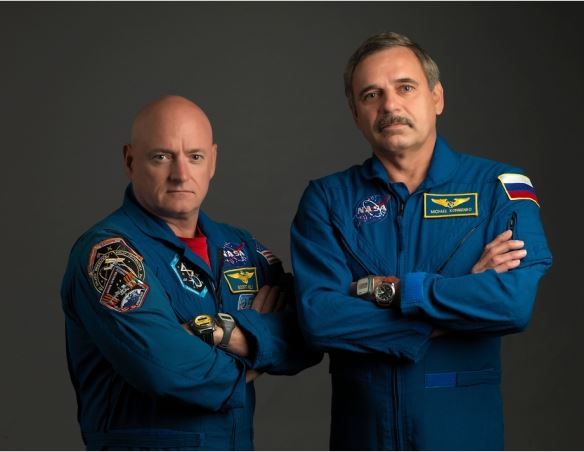

  Astronaut Scott Kelly and cosmonaut Mikhail Kornienko.
Source: NASA

The Kelly and Kornienko were interviewed by editor Alicia Maye of AOL.com. During the start of the interview Maye asked where they currently where located and Kelly replied with "We're over the Southern Hemisphere" and "going along the west coast of South America," and "heading South along the Andes." 

When Maye asked if they were feeling any effects from the 234 days they had spent on the ISS during the time of the interview, Kelly replied with he was sure about the muscle mass he may of lost or the radiation that he might have received while there and that they both wouldn't know the full effects until they get back home. Korinenko, through an interpreter said that he had, "better near vision, that he wasn't sure why and that scientist would tell him later. Kelly also said that he noticed that a "year in a long time," and that he felt that he lived his "whole life up here."

The men showed some cool tricks in their environment, like flipping with no hands and at one point in the interview at crew member floated past. Kelly said that the floating around makes some of the things that they have to do a bit harder but also provided a bit of humor saying that the environment was good for moving heavy things, than on Earth.  Maye asked a question from Twitter from topic #AskScottKellyOnAOL. The question was a inquiry on how the men stay mentally strong during their time in space. Kelly stated that NASA has a "good selection process and training," and that he felt "pretty well prepared." He also stated the sometimes he is "not 100% all of the time," but he "puts the whole thing in perspective," and that he will "be home someday" and that they do their "work with enough enthusiasm and energy to get job done." 

Much of their work includes running tests and collection data through use of imaging and ultrasounds as described by Kelly. He stated when asked about the ideal qualities for a candidate going on a journey to Mars, that ideally someone with a science and engineering background. Also having a military and operational background is good. He said that when things break down on the ISS they are the ones to fix them and though they have help on the ground it still is good for a person of kind of the "jack of all trades" to be in that kind of environment. There is a doctor on board the ISS and as Kelly mentioned if the doctor gets sick then they have to be the doctor, there is also a gym as stated by Korinenko.

 The full interview can be found on the AOL.com website.

Here are a few more screenshots taken from the interview:

 
Korinenko floats the microphone over to Kelly.
Korninenko shows his weightlessness.

Since Kelly been living on the ISS, he has been very active on Twitter, posting pictures of the Earth and other science related features form his view.

Here are a few of those tweets:


If you are thinking of becoming an astronaut, NASA recently opened up their Astronaut Selection Program and they are presently accepting applications.

The ISS is constantly moving about in space and ISS AstroViewer is a great site to track the station's current location.

The date set for the trip back home is set for March 2016.

The International Space Station.
Source: Wikipedia

Tuesday, December 4, 2012

NASA Social with Astronaut Joe Acaba


 Today was the NASA Social @NASASocial (previously NASA Tweetup) event with astronaut Joe Acaba @AstroAcaba, at NASA Headquarters in DC. I went with my husband. This is our third NASA Social. We were a tad bit late for this event. DC traffic got to us, not to mention I'm 39 weeks and 3 days pregnant. Even looking at the clock reading 9:58 am and knowing the event would start promptly at 10:00am, we were determined to get there.

When we finally got to the headquarters and sat quietly in the back and were able to catch some of Mr. Acaba's presentation about his four months aboard the International Space Station (ISS). From the NASA event website,"Acaba launched to the International Space Station on a Russian Soyuz spacecraft May 15. He spent 123 days aboard the orbiting laboratory as a flight engineer of the Expedition 31 and 32 crews. He returned to Earth Sept. 17 after four months off the planet."

After the presentation, the floor was opened for questions and answers, and many of the attendees asked great questions. Mr. Acaba spent most of his time in the copula. He was the sole US crew member aboard the craft, with two Russians cosmonauts. He said his Russian isn't that good. In the presentation we saw that there was exercising aboard the ISS, which he would do in his free time. He talked about working the robotic arm and supporting two of his crewmates during their space walk. He worked on scientific research experiments and preformed maintenance aboard the ISS.  He also gave insight into skills for becoming an astronaut. He said that we are all scientists if we have asked a question and the mission involved improvising, as planning for things to work a certain way, don't always go that way and studying hard. Mr. Acaba also spoke about working on a car and working using your hands. He also said he is not a fault if we take apart our parents car.

He was very informative and had a great sense of humor. He spoke about losing his spoon on the first day and that things float away. Upon his return to Earth he mentioned that it was hard to walk for the first week (gotta love gravity) and that the astronauts plan to land on the ground but they do partake in water survival training. Mr. Acaba made many points about the future of the space program, in one instance he said, "We are looking at going further than we've ever been." He included that he sees in the future, we'll be walking on Mars and living there.

@MsLinda22 asked Mr. Acaba a question from one of her twitter followers about seeing the effects of climate change from space. My ears perked up when I heard that question. His response was that we are not seeing climate change in real time, but comparing pictures from space taken from the ISS years ago to now, do show that the Earth is warming. "It's easy to see from space where everything is interconnected," he stated.  Mr. Acaba also answer questions in Spanish.

The goodie bag included a paper NASA Smallsat, which you can cut out and transform to make it into a cube. We also received an autographed portrait of Mr. Acaba, an information bookmark, a little booklet about space, a NASA sticker, a sticker of the Expedition 32 Patch and a pin of the same expedition. Like I said before, this is our third NASA social event. The ones we attended have all been at the NASA Headquarters in DC. In the near future we hope to attend the social events at other locations like Florida, Virginia and possibly California. I enjoy the events because they give you a behind the scenes look at some of the operations at NASA and allows you to connect with astronauts and people who have the same interest as you. We also hope to participate in more after the Social meetups. If you'd like to catch this event, NASA has the recording on their Youtube page.

For more about the NASA Social events, check out this link.
For more about Astronaut Joe Acaba, click here.

These are my other NASA Social blog entries.
STS-135 in DC
Astronaut Ron Garan

 During the Presentation.

The lights are on!

 Astronaut Joe Acaba.

 Me and my big belly.

 :-)

Thanks to @NASASocial and all who makes these events possible. Had a wonderful time!


***UPDATE*** I had my beautiful baby girl Dec 13!!!! She's into astronomy and knew she wanted to come during the Geminid meteor shower ;-)

Wednesday, February 15, 2012

NASA Tweetup with Astronaut Ron Garan

 Signed photograph of Astronaut Ron Garan.

Yesterday, my boyfriend Rex and I went to a special Valentine's Day edition of NASA Tweetup.  This was our second tweetup.  Our first tweetup was back in October 2011. The link to my blog entry on that adventure can be found here. We saw two astronauts, Sandy Magnus and Chris Ferguson from STS-135, the last space shuttle mission at NASA.

I found out I had been selected for the Ron Garan @Astro_Ron tweetup in Washington, DC on January 30th. I was delighted because only 150 people were randomly selected for this event and the last tweetup I had gone too, I had been on the waitlist. I replied with my response (heck yeah I was going...I didn't write that hehe) and was set for the February 14th tweetup.

From the NASA site, "Garan spent 164 days in space during the Expedition 27 and Expedition 28 missions to the International Space Station. He and his crewmates launched April 4, 2011, and returned to Earth on Sept. 15, 2011. Aboard the station, the crew worked on a variety of microgravity experiments and hosted two space shuttle missions, including the last shuttle to visit the station. Garan also participated in the last space-shuttle-based spacewalk during the STS-135 mission." Garan also took pictures of his time in space and shared them on his Twitter account and on his blog Fragile Oasis blog.

There were many people at the event. Some of the farthest came from Arizona and California.  There was a large show of hands, for first time attendees and it was nice seeing a big addition to the NASA tweetup family.  A full list of the attendees can be found here. Thank you to everyone who contributes towards putting the wiki together :-)

At the tweetup we introduced ourselves by our twitter handle and expressed our gratitude towards Stephanie Schierholz @schierholz, who stated that this was her last tweetup for NASA and was her last official event as an employee of NASA. She has moved on to Raytheon. Garan was very personable and had a great sense of humor. He answered many of the audience's questions. One of my favorites was about Underseas Laboratories. Garan explained about his life and space and mentioned events like viewing lightning storms, auroras, and watching falling meteorites, as some of his favorite moments in space. He also likes seeing the lights on Earth. He discussed the idea of energy from the moon and how it is greater because it doesn't go through the atmosphere, nor is it hindered by weather.  He talked what he missed on Earth while at the International Space Station (ISS) and his told of a time when space junk was headed toward the ISS and that he and his other crewmates had practiced for moments like that. Thankful the space junk did not hit the ISS. Garan stated that the smell of space, is burnt metal and that space exploration is learning about life on Earth from an outside view. "Nothing is impossible," he said.

A sequel to the ISS Blues was shown at the event and displayed Garan playing his guitar and other crewmates. The first ISS Blues was shown back in September 2011. According to Garan, "You gotta have fun, or else you'll go crazy." A timelapse of the ISS flyover Earth was shown as well. It was absolutely breathtaking seeing the lights on Earth and the aurora. I drooled at the aurora. The event ended with a special presentation for Stephanie, honoring her for all the work she's done helping to put NASA in a more social media environment. I'd like to thank NASA, Stephanie, Astronaut Ron Garan and the everyone else involved in the production of this tweetup. It is a great way to connect with NASA and I hope to attend many more in the future. It's also a wonderful way to meet new people. Shout out to my NASA Tweetup family :-)  Here are some pictures from the event:

 My boyfriend Rex and I with our badges. 


 So cute.

 The stage.

 Astronaut Ron Garan. 


 Stephanie receiving her gift from NASA. 
Here is a picture Stephanie tweeted of her gift.

Some goodies we got from NASA:

 Headshots of Astronaut Ron Garan. This includes the signed photograph featured at the top of the blog post.

 :-)

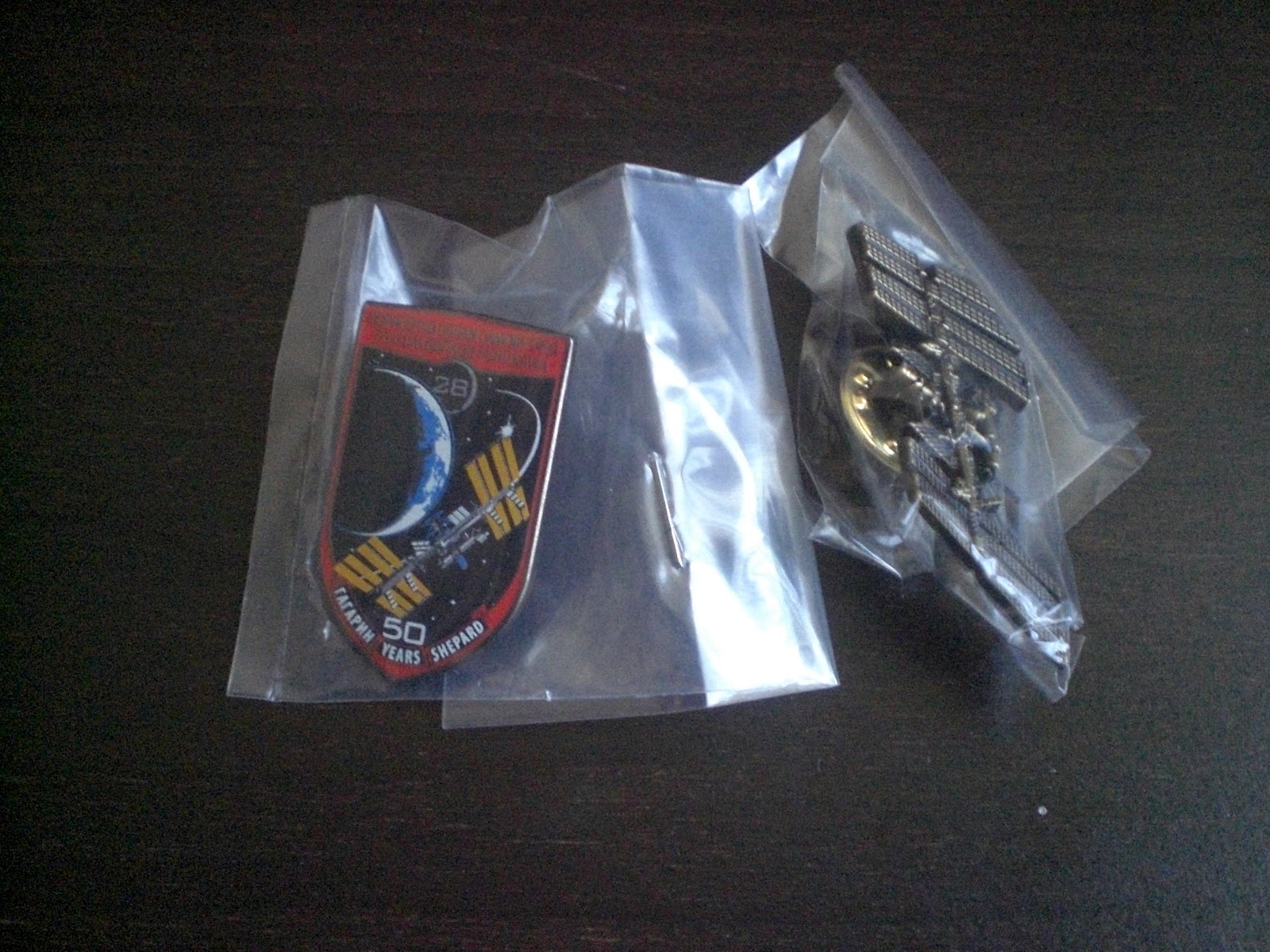
 A pin of the ISS and of the Expedition 28 mission. 

Our badges.

For more information about Ron Garan, check out this link.

"We are all riding on a spaceship, we call Earth," - Ron Garan.

Friday, October 14, 2011

NASA Tweetup STS-135 in Washington, DC

          Yesterday, I got the chance to see astronauts Christopher Ferguson @Astro_Ferg and Sandy Magnus @Astro_Sandy at the NASA Tweetup STS-135 event in Washington, DC.  If you are wondering what a Tweetup is, according to NASA a tweetup is "...An informal meeting of people who use the social messaging medium Twitter. NASA Tweetups provide @NASA followers with the opportunity to go behind-the-scenes at NASA facilities and events and speak with scientists, engineers, astronauts and managers. NASA Tweetups range from two hours to two days in length and include a "meet and greet" session to allow participants to mingle with fellow Tweeps and the people behind NASA's Twitter feeds." People that follow @NASATweetup also are provided the opportunity to attend and the account features the latest information about NASATweeup events.  The first NASATweetup was On January 21, 2009 at NASA's Jet Propulsion Laboratory.
         I saw that NASA was having a tweetup at their headquarters in Washington, DC through my @weathersavvy1 account and I registered during the September 29th to September 30th period.  I saw that 150 participants would be selected at random and I crossed my fingers. On October 4th I received an email from Social Media Manager and Public Affairs Specialist at NASA, Stephanie Schierholz @schierholz, that I was not selected and I was on the waiting list. I crossed my fingers again and on October 6th, I received the confirmation that I had been selected!
       The event started at 4:00 pm EST, and was an hour long. At the event highlights of the STS-135 mission and the space program were discussed. STS-135 had actually started out as a rescue mission, delivering 9,400 pounds of spare parts and 2, 677 pounds of food. This is to help operations at the space station for the next year. The mission also brought back 5,7000 pounds of material from the station that was not needed. STS-135 was the final shuttle flight and also the 135th space shuttle to go into outer space.  25 states where represented at the event with the farthest United States attendees, coming from California. Attendees also came from Canada and Germany. The event was also broadcasted live on the NASA website.
      I wrote about STS-135 back in July when the space shuttle successfully landed on July 21, 2011. Here is that blog entry. I would have never thought, that some three months after writing that entry, I'd be seeing two of the astronauts aboard the space craft in person, and getting my picture with Sandy Magnus. Here is that picture:


I also got her signature :-)


      The event was amazing and I really want to thank everyone who made this event possible. It is a great way to connect with the NASA and people that share common interests. Our world is definitely changing and like Astronaut Sandy Magnus said, "It's about learning." It was my first NASA Tweetup and I will assure, it definitely won't be my last :-)

Here are more pictures from the event:

 Me in front of the NASA building


 Astronauts Christopher Ferguson and Sandy Magnus.

 The program.

 List of the participants.


 The NASA swag bag.


 The commemorative pin, it contains metal flown aboard a space shuttle!


 For more information about the STS-135 mission, check out this link.

Thanks again everyone involved, for this amazing opportunity and thank you to my boyfriend, Rex for taking some of the photos.

Thursday, July 21, 2011

Space Shuttle Atlantis' Landing Marks End Of NASA's 30-Year Space Program

It's the end of a 30-year era. Space Shuttle Atlantis has safely landed at 5:58 a.m. EDT at NASA's Kennedy Space Center in Florida. The Space Shuttle's flight lasted 12 days, 18 hours, 28 minutes and 55 seconds.

To read more about the historic occurrence, check out this link. They have a bittersweet video of Space Shuttle Atlantis' landing, which the picture below is a screenshot of.

Sunday, July 17, 2011

Space Weather Revisited

I'm a meteorologist and currently I'm researching some of the chemical aspects behind air quality. I know that sounds very vague but more well be developing over the summer and much into my next school year. I'm really fascinated by weather that occurs within the Troposphere and in the Stratosphere. Tornadoes, hurricanes, thunderstorms, they amongst many other weather occurrences are spectacular phenomenons. They however, can be very deadly and finding out ways to better educate the public on them is something I like to do too.

I also am really fascinated by the weather that occurs in Thermosphere, Ionosphere and beyond. A good example of this, is the Aurora Borealis. This phenomena is actually one of my favorite weather phenomenons, though you may be thinking that's not a tornado or weather we are more likely to see everyday. You may even be thinking the Aurora Borealis, is not even weather. Although it is not within the planetary atmosphere of the Earth, the Troposphere and Stratosphere, the Aurora is due to a change in the atmosphere. This is much like the weather we see closer to Earth. Our weather changes due to changes in the atmosphere and other atmospheric processes.

The term for weather like the Aurora Borealis is called Space Weather and currently Space Weather is a very growing field. I have been to a few conferences including the 33rd Annual National Weather Association conference in Louisville, KY, the 90th Annual American Meteorological Society conference in Atlanta, Georgia, and the 91st Annual American Meteorological Society conference in Seattle, Washington, and at all of those conferences, there have been presentations on Space Weather.

I saw a picture on a CNN News Blog and was motivated to write this entry. Here's the picture below:


The picture is of the Southern Lights taken by a member of the Space Shuttle Atlantis. Atlantis recently launched on July 8, and marked the final mission of NASA's 30 year Space Shuttle Program. Isn't it spectacular?

The Aurora Borealis is a very well known space weather phenomenon, in what may sound reminiscent of my July 20, 2009, a few others include solar flares, meteor showers and solar flares and I'll add a new one coronal holes.

As mentioned in the post, only one ground phenomenon that can propagate into outer space and that is a lightning. What is created is called a blue jet. Here is a picture from Wikipedia showing this phenomenon in more detail:


According to Wikipedia, blue jets can reach to "the lowest levels of the ionosphere 25 miles (40 km) to 50 miles (80 km) above the Earth."

So if you see on my blog, postings about hurricanes, or solar flares, I'm just posting about weather near and far :-)

To learn more about Space Weather visit this link.

Bonus!

Now this is much more astronomy, but here's a picture I posted to my Flickr, of the full moon taken by my friend Drew, on July 16. It was with my Casio Exilm EX-277. I was really surprised at how well, he got this shot of the moon. It is a tad blurry, though. Haha.

Sunday, July 10, 2011

Storms On Saturn


I'm sure you're heard about the Red Eye on Jupiter, a gathering of magnificent storms, now Saturn has it's own unique gathering.

A recent article by Carolyn Porcotalks about this phenomena:

Tempest-from-hell seen on Saturn
"Imagine being caught in a thunderstorm as wide as the Earth with discharges of lightning 10,000 times more powerful than normal, flashing 10 times per second at its peak.

Now imagine that this storm is still unfolding, eight months later.

One of the most violent weather events in the Solar System began to erupt on Saturn last December and is still enthralling astronomers, the British journal Nature reported on Wednesday.

Two studies draw on observations by professional and amateur astronomers using a broad range of gear, from relatively small ground-based telescopes to NASA's magnificent scoutcraft, Cassini.

Saturn, like Jupiter, is no stranger to convective storms.

It too is a "gas giant," or planet comprising layers of thick, roiling gases rather than a rock, like Earth, Mars, Venus and Mercury.

The difference, though, is that jovian mega-storms tend to erupt unexpectedly, but the lord of the rings gives birth to a monster almost periodically.

It occurs on average once every Saturnian year -- nearly 29.5 Earth years -- and appears to be linked to the summer solstice, when the planet's orbit brings it a bit closer to the Sun and its atmosphere warms a little.

The event is known as the "Great White Spot" (a counterpart to the swirling "Great Red Spot" on Jupiter) because of the mass of brilliant white storm clouds that erupt in the upper atmosphere.

The show is so big that it can be visible by telescopes from distant Earth. Five have been observed in the last 130 years. The last occurred in 1990.

But the current Great White Spot is proving to be a dazzling spectacle, revealed by an unprecedented array of observational power at hand.

Events began at 2105 GMT on December 5, when ground-based telescopes detected a "barely visible white point" on a normally unblemished and hazy part of Saturn's northern hemisphere, at around latitude 35 degrees north.

At the same time, Cassini turned its "ears" towards the target, listening in to radio emissions from the storm via an onboard plasma-wave instrument.

These signals are the telltales of lightning. Lightning cannot be seen visually on Saturn at night because of interference from sunlight scattered from the planet's ring system, which comprises billions of shiny particles.

Within a few weeks, the point had ballooned into a storm system that was some 10,000 kilometers (6,000 miles) across, roughly comparable with the diameter of the Earth, and after two months the clouds had almost encircled the entire planet.

Analysis of the data suggests that the "spot" is in fact a cluster of super-storms, produced by upwelling of heat, moisture and ammonia from water clouds from lower down in the Saturnian atmosphere, where the pressure is high.

As this mix rises into a cooler atmospheric layer called the tropopause, bright, white clouds of ammonia start to spread horizontally into a tail, sculpted by eastward jets of wind.

Astronomers are especially intrigued by the current Great White Spot.

The observational history of this phenomenon is sketchy. But evidence suggests the present spot is exceptionally intense and rather premature, for it was still spring on Saturn when the storm brewed."

Wednesday, June 8, 2011

Solar Flare Disrupting Earth?

Here's an article I saw on Yahoo about the most recent solar flare on June 7. What could this mean for us here on Earth? Read below:

Article by Kerry Sherdian

"WASHINGTON (AFP) – An unusual solar flare observed by a NASA space observatory on Tuesday could cause some disruptions to satellite communications and power on Earth over the next day or so, officials said.
The potent blast from the Sun unleashed a firestorm of radiation on a level not witnessed since 2006, and will likely lead to moderate geomagnetic storm activity by Wednesday, according to the National Weather Service.
"This one was rather dramatic," said Bill Murtagh, program coordinator at the NWS's Space Weather Prediction Center, describing the M-2 (medium-sized) solar flare that peaked at 1:41 am Eastern time in the United States, or 0541 GMT.
"We saw the initial flare occurring and it wasn't that big but then the eruption associated with it -- we got energy particle radiation flowing in and we got a big coronal mass injection," he said.
"You can see all the materials blasting up from the Sun so it is quite fantastic to look at."
NASA's solar dynamics observatory, which launched last year and provided the high-definition pictures and video of the event, described it as "visually spectacular," but noted that since the eruption was not pointed directly at Earth, the effects were expected to remain "fairly small."
"The large cloud of particles mushroomed up and fell back down looking as if it covered an area of almost half the solar surface," said a NASA statement.
Murtagh said space weather analysts were watching closely to see whether the event would cause any collision of magnetic fields between the Sun and Earth, some 93 million miles (150 million kilometers) apart.
"Part of our job here is to monitor and determine whether it is Earth-directed because essentially that material that is blasting out is gas with magnetic field combined," he told AFP.
"In a day or so from now we are expecting some of that material to impact us here on Earth and create a geomagnetic storm," he said.
"We don't expect it to be any kind of a real severe one but it could be kind of a moderate level storm."
The Space Weather Prediction Center said the event is "expected to cause G1 (minor) to G2 (moderate) levels of geomagnetic storm activity tomorrow, June 8, beginning around 1800 GMT."
Any geomagnetic storm activity will likely be over within 12-24 hours.
"The Solar Radiation Storm includes a significant contribution of high energy protons, the first such occurrence of an event of that type since December 2006," the NWS said.
As many as 12 satellites and spacecraft are monitoring the heliosphere, and one instrument in particular on board NASA's lunar reconnaissance orbiter is measuring radiation and its effects.
"Certainly over the (two-year) lifetime of the mission this is the most significant event," said Harlan Spence, principal investigator for the cosmic ray telescope for the effects of radiation, or CRaTER.
"This is really exciting because ironically when we were developing the mission initially we thought we would be launching closer to a solar maximum when these big solar particle events typically occur," Spence told AFP.
"Instead we launched into a historic solar minimum that took a long, long time to wake up," he said.
"This is interesting and significant because it shows the Sun is returning to its more typical active state."
The resulting geomagnetic storm could cause some disruption in power grids, satellites that operate global positioning systems and other devices, and may lead to some rerouting of flights over the polar regions, Murtagh said.
"Generally it is not going to cause any big problems, it will just have to be managed," he said.
"If you fly from the United States to Asia, flying over the North Pole, there are well over a dozen flights every day," he added.
"During these big radiation storms some of these airlines will reroute the flights away from the polar regions for safety reasons to make sure they can maintain communications.
"People operating satellites would keep an eye on this, too, because geomagnetic storming can interfere with satellites in various ways whether it is the satellite itself or the signal coming down from the receiver."
The aurora borealis (Northern Lights) and aurora australis (Southern Lights) will also likely be visible in the late hours of June 8 or 9, NASA said."
Source

Tuesday, July 21, 2009

It's Eclipsic

OK so I don't know if eclipsic is a word but what I do know is that I'm referring to the longest duration of a total solar eclipse in the 21st century, which is set to occur tomorrow, in central and northeastern India, Bhutan, Bangladesh, Myanmar, China, and the Ryukyu Islands. A partial solar eclipse is set to occur in Southeast Asia, Japan, the Philippines, Indonesia, Central Pacific Ocean area and its islands. An eclipse of any sort won't be happening here in America though :-(

It's been almost a year sense the last total solar eclipse which captured in Nunavut, northern Greenland, central Russia, western Mongolia, and western China on August 1, 2008. The most recent solar eclipse was an annular eclipse early this year, on January 26, 2009. That eclipse was seen in southeast Sumatra, Jakarta and Borneo. So what actually is the cause of a solar eclipse? Well a solar eclipse is the result of when a new moon passes between the sun and the Earth. By doing this the sun appears to be totally or partially covered, which is amazing considering the size difference of the two masses. In earlier times when solar eclipses were not as well known, the event could be seen as very ominous and scary. For a few seconds to a few moments, the sun is literately blocked out during a total eclipse and the sky is dark. For 6 minutes and 39 seconds the area in the path of the total solar eclipse on July 22, 2009 will be dark. The next time for a duration near the time of this historic event, won't be until June 13, 2132.

Eclipses are a truly remarkable natural phenomenon and are one of the many displays of nature's beauty and magnificence. Though most of these events, when they do actually occur, are not contiguous across the globe, when they do happen, it is best to view it firsthand. The last time I remember seeing a solar eclipse in America (and I'm 22) is on Christmas Day in 2000. I remember my father purchasing special "Solar eclipse Christmas 2000" glasses, so that our eyes would be shielded from the sun's rays. It was a special time that I got to share with my family that day and even more special because of the rarity of such an event. I'm happy I got to view the eclipse and although it was partial, the next predicted date for a solar eclipse occurring on Christmas Day isn't until 2307!

Fear not, that year is only for a predicted solar eclipse occurring on Christmas Day. Many solar eclipses will happen before that year, with a estimated 224 solar eclipses estimated for 2001 to 2100 AD. Though many will not be visible for the United States, mark this down on your calendar...the next time a solar eclipse will be visible for the US is May 20, 2012. It won't be a total eclipse but an annular eclipse (this is when the new moon is completely aligned with the sun and covers the center of the sun). The next time for a total eclipse won't be until July 11, 2010 and that will be visible southern Chile and Argentina and southeastern Polynesia. I might book a flight to Polynesia to see that one...

Wednesday, April 15, 2009

Watchful eye on Asteroid Apophis

I was browsing on AOL yesterday and an article on Asteroid Apophis caught my interest. I love studying the weather and the causes and effects of the movement of the atmosphere, but I also love reading and learning about Earth Science and the various aspects which make up our gorgeous planet.
The asteroid is the size of a 25-story building and on April 13, 2029 the asteroid will come relatively close to Earth, within 18,000 miles as a matter of fact. The odds of the asteroid colliding with the Earth is 1 in 45,000 and the probability is 2.7% but still after reading this article I found that this asteroid is a little too close for comfort. Also the name Apophis is Greek and comes from the ancient Egyptian god Apep of darkness and chaos. It received this name because it was rated number 4 on the Torino Impact Hazard Scale (where 0 is the lowest and 10 is the highest), for 2 years after it’s discovery in 2004. The asteroid has since dropped to 0 for the 2029 date, however predictions for possible impact in April 13, 2036, has given the asteroid a numer 1 rating for that date.
There are many asteroids, comets and other space matter that come close to hitting the Earth or fall through the Earth’s atmosphere every day. Scientists keep watchful eyes on these objects in case one such like that of Asteroid Apophis which can potentially come close to colliding with the Earth. Though many of these object pass by the planet, some space matter does hit. In 1908 an asteroid around 50 meters in length, exploded over an unpopulated area of Russia, leveling trees for 800 miles. Then there’s always that 6.2 mile asteroid which is thought to have lead to the extinction of dinosaurs.
The data collected is all from the projected path of the asteroid and considering the date of 2029, the risk factor may be years away but this asteroid still shows the possibility that as the planet is floating around in outer space, an object such like that of an asteroid can strike it. Let’s hope in 2029 the asteroid will just pass the planet with no harm. It would be cool to see the asteroid though with a telescope or with naked eye as you can in the event of a meteor shower or lunar eclipse.
Link to the article can be found at: http://news.aol.com/article/asteroid-apophis/426922
For more information on Asteroid Aphohis visit: http://neo.jpl.nasa.gov/apophis/